
Salud mental: Pasado, Presente y Futuro
Las heridas del pasado junto con un ego desequilibrado, pueden afectar el futuro al generar patrones de conducta, miedos y creencias que condicionan el presente. Para sanar, es necesario tener un ego equilibrado para aceptar y procesar dolor y redefinir la narrativa personal para romper patrones, lo que libera la capacidad de vivir plenamente el presente y por ende construir un futuro más saludable.
¿existe un ego colectivo?
En un intento creativo de ponerle nombre al ego colectivo, he creado E.G.O cuyas siglas significan Experiencias Gubernamentales Organizadas y expresa el desequilibrio de cualquier colectivo político que intenta justificar lo injustificable (por ejemplo, la matanza de civiles o un genocidio) en la defensa de una ideología.

Jiddu Krishnamurti sostenía que toda ideología, al fundamentarse en dogmas, creencias o sistemas, crea divisiones y conflicto, los cuales son la raíz de la violencia y las guerras. Para él, la ideología es una construcción del «yo» que necesita aislarse y afirmarse contra otros, impidiendo la cooperación y la paz. Su pensamiento aboga por un cambio individual hacia la libertad interior, que surge de la observación directa y la comprensión de uno mismo, liberándose de cualquier dogma o sistema externo para acabar con la violencia en el mundo.
No existe una etapa de la historia humana que haya sido completamente pacífica a nivel mundial, ya que la paz absoluta lamentablemente es un concepto todavía ideal y la violencia siempre ha sido una gran parte de la experiencia humana. El concepto de paz ha evolucionado desde la segunda guerra mundial, pues no es solo ausencia de conflictos o guerra, sino es un fin, un objetivo imprescindible para ejercer y disfrutar los derechos humanos, en otras palabras, la paz, es sinónimo de promoción y respeto de derechos humanos.
La guerra deshumaniza y genera un Ecocidio que contamina atrozmente la Tierra y nuestros corazones.
La Paz es la mejor virtud del ser humano para el bienestar, físico y psicológico, del individuo y del colectivo.
Paz, Paz, Paz
Danchú
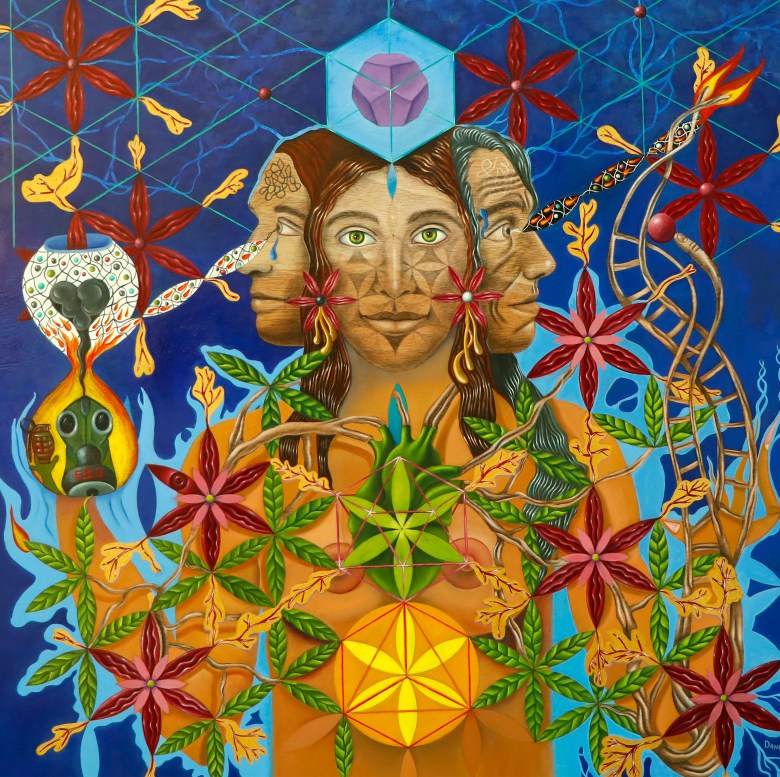
MENTAL HEALTH, Past, Present, and Future, oil and charcoal on wood.
The left side represents the past connected to an hourglass in which the ego, trapped in a space-time loop of suffering (caused by traumatic and emotionally unresolved experiences), is directly transmitted to the right side, which represents a future created from the memory of the past. In the center, I represent the present unconditioned by the past, the present that connects with the fullness of the eternal in the here and now, where the harmony of being reigns and where "instant understanding" and sanity reside.
Wounds from the past, along with an unbalanced ego, can affect the future by generating patterns of behavior, fears, and beliefs that condition the present. Healing requires a balanced ego to accept and process pain, redefine your personal narrative to break patterns, which unleashes the ability to fully live in the present and thus build a healthier future.
Is there a collective ego?
In a creative attempt to name the collective ego, I created E.G.O, whose acronym stands for Experiencias Gubernamentales Organizadas (Organized Governmental Experiences) and expresses the imbalance of any political collective that attempts to justify the unjustifiable (for example, the killing of civilians or genocide) in the defense of an ideology.
Jiddu Krishnamurti maintained that every ideology, when based on dogmas, beliefs, or systems, creates divisions and conflict, which are the root of violence and war. For him, ideology is a construct of the "self" that needs to isolate itself and assert itself against others, preventing cooperation and peace. His thinking advocates an individual shift toward inner freedom, which arises from direct observation and self-understanding, freeing oneself from any external dogma or system in order to end violence in the world.
There is no period in human history that has been completely peaceful worldwide, as absolute peace is unfortunately still an ideal concept, and violence has always been a large part of the human experience. The concept of peace has evolved since the Second World War, as it is not simply the absence of conflict or war, but is an end, an essential objective for exercising and enjoying human rights. In other words, peace is synonymous of the promotion and respect for human rights.
War dehumanizes and generates an ecocide that atrociously pollutes the Earth and our hearts.
Peace is the greatest human virtue for the physical and psychological well-being of the individual and the community.
Peace, Peace, Peace
Danchú
 Danchú